
Accounts payable is money your business owes suppliers. Accounts receivable is money customers owe your business. Both usually arise because goods or services are supplied now and paid for later, but they sit on opposite sides of the transaction.
That distinction sounds simple, yet it affects who owns the work, which checks matter, how entries are recorded and when cash is expected to leave or enter the bank. The clearest comparison starts with the direction of the obligation.
1. The core difference at a glance
A supplier has extended credit to you
Your business has received value and must pay. The outstanding amount is normally a current liability and will create a future cash outflow.
You have extended credit to a customer
Your business has delivered value and expects payment. The outstanding amount is normally a current asset and should create a future cash inflow.
The word invoice can describe either side, so perspective matters. A supplier invoice received by your business belongs in AP. A sales invoice issued by your business belongs in AR. They are not the same accounting record, even if the commercial transaction links two businesses.
2. What accounts payable is responsible for
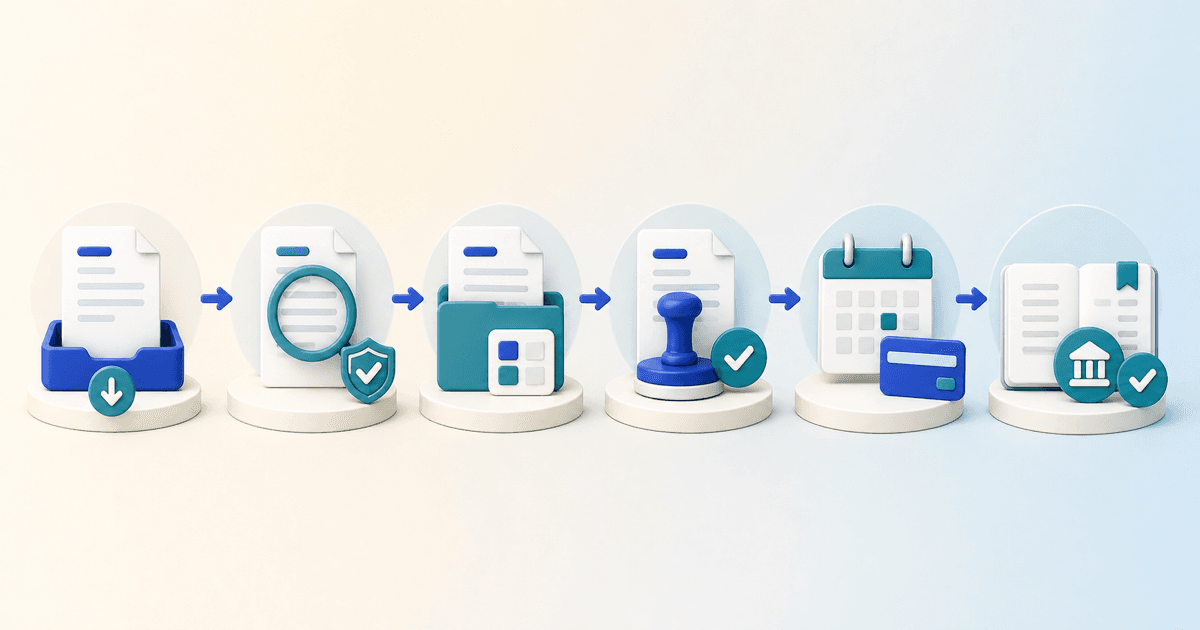
AP turns an incoming supplier invoice into a valid, approved and correctly recorded obligation. The process normally receives the original invoice, verifies the supplier and required details, checks for duplicates, matches the purchase, prepares coding and tax treatment, obtains approval, posts the bill, pays it when due and reconciles the outcome.
The main risks are paying something invalid, paying the same invoice twice, using unverified bank details, recording the cost incorrectly or paying too late. Strong AP controls therefore focus on evidence, approval authority, supplier data changes, separation of duties and a complete record from receipt to payment.
For the detailed route, see How to process an invoice from receipt to payment.
3. What accounts receivable is responsible for
AR turns a completed sale into a collectible customer balance. The process creates an accurate sales invoice, sends it promptly, records the receivable, allocates incoming cash, investigates deductions or disputes, follows up overdue balances and reconciles the customer account.
Its main risks are failing to invoice delivered work, billing the wrong amount, granting unsuitable credit, overlooking a dispute or collecting too slowly. AR controls focus on complete and accurate billing, customer credit limits, clear payment terms, disciplined collection activity, controlled credit notes and correct allocation of receipts.
A sale is not finished from a cash perspective when the invoice is issued. It is finished when the payment is received, identified and applied to the right balance.
4. How each side affects accounting and cash
AP entry: recording a supplier bill normally credits accounts payable and debits an expense, asset or other account. Paying it debits accounts payable and credits the bank.
AR entry: recording a customer invoice normally debits accounts receivable and credits revenue and any relevant tax account. Receiving payment debits the bank and credits accounts receivable.
AP and AR are balance sheet accounts, not income statement categories. The underlying purchase or sale may affect profit, but settling the outstanding balance usually moves value between the balance and cash rather than creating a second expense or sale.
Two useful measures are days payable outstanding, which describes how long the business takes to pay suppliers, and days sales outstanding, which describes how long it takes to collect customers. Neither number should be optimised blindly. Delaying valid supplier payments can damage supply and terms; pushing every customer too aggressively can damage good relationships.
5. The controls and owners are different
AP asks, “Is this obligation genuine, accurate, approved and safe to pay?” AR asks, “Was everything delivered billed accurately, and is the balance collectible?” Those questions require different evidence and should not be collapsed into one generic invoice process.
AP commonly works with procurement, budget owners, receiving teams, tax reviewers and payment approvers. AR commonly works with sales operations, customer service, credit control, billing teams and cash application. The general ledger team connects both at period end and resolves balances that do not agree with supporting records.
6. Manage AP and AR together for working capital
Although the processes remain separate, finance should view their timing together. A short cash forecast should compare approved supplier payments and other outflows with expected customer receipts and available cash. This exposes a gap before the bank balance becomes the warning.
At month end, review aged payables, aged receivables, disputed items, unapplied cash, unrecorded liabilities, credit notes and reconciliations. Investigate old balances rather than rolling them forward without explanation. AP may contain duplicate or disputed supplier claims; AR may contain invoices that are no longer fully collectible.
Do not automatically offset what a company owes you against what you owe it. Netting may require a contractual right, the same legal counterparties and appropriate accounting treatment. Keep the gross balances visible unless the conditions for offset are genuinely met.
Using ArrowBill on the payable side
ArrowBill is designed for the AP side of this comparison. It captures incoming supplier invoices, checks their details, identifies possible duplicates, connects purchase evidence, routes approvals and keeps the complete record with the bill sent to accounting software.
Your sales and accounting systems can continue to manage customer invoicing and collection. Keeping that boundary clear gives finance a reliable view of supplier obligations alongside receivables without treating two different control processes as if they were interchangeable.
Make supplier invoices easier to control
Use ArrowBill to move incoming invoices from capture through approval and into your accounting platform with the source document and decision history connected.
Frequently asked questions
What is the simplest difference between AP and AR?
Accounts payable is money your business owes suppliers. Accounts receivable is money customers owe your business. AP is normally a liability and AR is normally an asset.
Can the same company appear in both AP and AR?
Yes. A company can buy from you and sell to you. Keep the payable and receivable records distinct, and offset them only where a valid legal right and appropriate accounting treatment exist.
Are accounts payable and receivable income statement accounts?
No. They are balance sheet accounts. The related purchase or sale may affect profit, but AP and AR show the amount still outstanding at a point in time.
Which is more important, AP or AR?
Both. AR protects revenue collection and incoming cash; AP protects valid spending, supplier relationships and outgoing cash. Weakness on either side can create a working-capital problem.
 Published guide
 Published guide
 Published guide
 Published guide